| PERSISTENT IDENTIFIERS |
|---|
| ARK: https://n2t.net/ark:/85846/ |
| ISNI-0000 0005 1437 3999 |
| SUBMIT BOOK PROPOSAL |
| Submit Book |
| ADDITIONAL MENU |
| Peer Review Policy |
| Editor's Guidelines |
| Reviewer's Guidelines |
| Author's Guidelines |
| INFORMATION |
| For Readers |
| For Authors |
| For Librarians |
| VYOM HANS JOURNALS |
| Graduate Journal of Interdisciplinary Research, Reports & Reviews |
| Journal of Green Lifestyle and International Market |
| Journal of Educational Research & Bibliometric Studies |
| WHATSAPP GROUP |
| Join WhatsApp Group |
| CREDIT |
| PLATFORM & WORKFLOW OMP/PKP |
INDUCTION AND INHERITANCE OF DETERMINATE GROWTH HABIT IN BLACKGRAM (VIGNA MUNGO (L.) HEPPER)
Synopsis
The purpose of this study is to evaluate the effects of DT induction and inheritance in blackgram (Vigna mungo L. Hepper) by the use of mutagenesis. Since blackgram is mostly a self-pollinating species, hybridization isn't an option; therefore, mutant breeding is a good way to get desirable traits. Two blackgram cultivars, AKU-15 and Black Gold, were subjected to treatments of gamma irradiation (100-400 Gy) and electromagnetic fields (0.1-0.4%) in order to promote determinate development. With a primary emphasis on the 300-400 Gy gamma and 0.3-0.4% EMS treatments, the study investigated DT mutants with terminal and axillary inflorescences. Researchers found evidence of a recessive digenic epistatic model for DT development in the segregating generations (F1 to F4), with a ratio of 3:13. Studies have shown that by breeding mutants, a consistent growth habit may be achieved, which could be used as a genetic resource for better blackgram cultivation.
Keyword: Blackgram, Vigna mungo, mutation breeding, determinate growth, inheritance
Downloads
Pages
163-168
Published
April 11, 2025
Categories
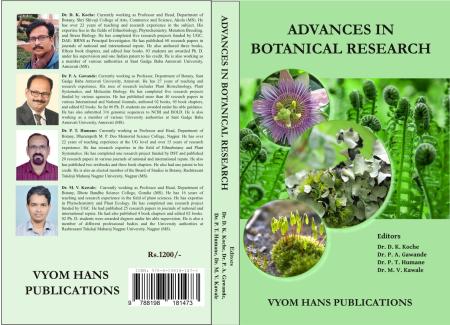
Copyright (c) 2025 Dr. D. K. Koche , Dr. P. A. Gawande , Dr. P. T. Humane , Dr. M. V. Kawale (Volume editor)
How to Cite
Sunanda M. Dekate, & D. K. Koche. (2025). INDUCTION AND INHERITANCE OF DETERMINATE GROWTH HABIT IN BLACKGRAM (VIGNA MUNGO (L.) HEPPER) . In Dr. D. K. Koche, Dr. M. V. Kawale, Dr. P. T. Humane, & Dr. P. A. Gawande (Eds.), & Amol Pimpalshende, ADVANCES IN BOTANICAL RESEARCH (pp. 163-168). Vyom Hans Press. https://doi.org/10.34256/adbor.25.20.163