| PERSISTENT IDENTIFIERS |
|---|
| ARK: https://n2t.net/ark:/85846/ |
| ISNI-0000 0005 1437 3999 |
| SUBMIT BOOK PROPOSAL |
| Submit Book |
| ADDITIONAL MENU |
| Peer Review Policy |
| Editor's Guidelines |
| Reviewer's Guidelines |
| Author's Guidelines |
| INFORMATION |
| For Readers |
| For Authors |
| For Librarians |
| VYOM HANS JOURNALS |
| Graduate Journal of Interdisciplinary Research, Reports & Reviews |
| Journal of Green Lifestyle and International Market |
| Journal of Educational Research & Bibliometric Studies |
| WHATSAPP GROUP |
| Join WhatsApp Group |
| CREDIT |
| PLATFORM & WORKFLOW OMP/PKP |
HPTLC FINGERPRINTING OF RUELLIA TUBEROSA L., A MEDICINAL HERB
Synopsis
Ruellia is a genus of flowering plants commonly known as Wild Petunias which belongs to the family Acanthaceae. It contains about 250 genera and 2500 species. Most of these are shrubs or twining vines; some are epiphytes. Some of these are used as medicinal plants. The phytochemicals constituents: glycosides, alkaloids, flavonoids and terpenoids are present. The genus has been traditionally claimed to be used for the treatment of flu, asthma, fever, bronchitis, high blood pressure, eczema, and diabetes. Present study is an attempt to identify some phytochemical markers in R. tuberosa. HPTLC fingerprinting was carried out for various extract of leaf, stem and root of R. tuberosa. HPTLC fingerprint revealed 6 types of 12 phenolic compounds, 4 types of 8 flavonoids and 4 alkaloids. The identified compounds are possibly imparting medicinal value to the plant and this chemical screening will be helpful for developing pharmacopeial standards for R. tuberosa.
Keyword: Ruellia tuberosa, Acanthaceae, HPTLC, Pharmacopeial.
Downloads
Pages
177-182
Published
April 11, 2025
Categories
Copyright (c) 2025 Dr. D. K. Koche , Dr. P. A. Gawande , Dr. P. T. Humane , Dr. M. V. Kawale (Volume editor)
How to Cite
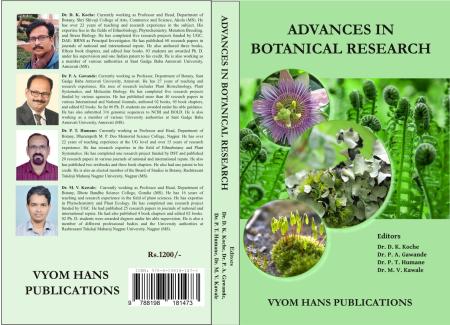
Tripty Jagtap, & D. K. Koche. (2025). HPTLC FINGERPRINTING OF RUELLIA TUBEROSA L., A MEDICINAL HERB . In Dr. D. K. Koche, Dr. M. V. Kawale, Dr. P. T. Humane, & Dr. P. A. Gawande (Eds.), & Amol Pimpalshende, ADVANCES IN BOTANICAL RESEARCH (pp. 177-182). Vyom Hans Press. https://doi.org/10.34256/adbor.25.22.177