| PERSISTENT IDENTIFIERS |
|---|
| ARK: https://n2t.net/ark:/85846/ |
| ISNI-0000 0005 1437 3999 |
| SUBMIT BOOK PROPOSAL |
| Submit Book |
| ADDITIONAL MENU |
| Peer Review Policy |
| Editor's Guidelines |
| Reviewer's Guidelines |
| Author's Guidelines |
| INFORMATION |
| For Readers |
| For Authors |
| For Librarians |
| VYOM HANS JOURNALS |
| Graduate Journal of Interdisciplinary Research, Reports & Reviews |
| Journal of Green Lifestyle and International Market |
| Journal of Educational Research & Bibliometric Studies |
| WHATSAPP GROUP |
| Join WhatsApp Group |
| CREDIT |
| PLATFORM & WORKFLOW OMP/PKP |
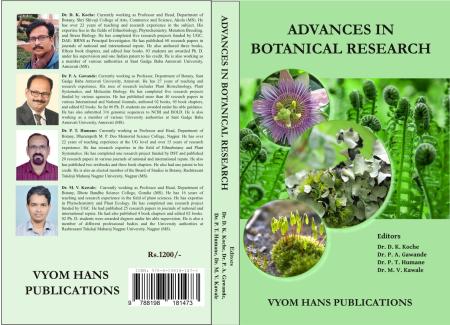
FLORISTIC ANALYSIS OF HARDA DISTRICT, MP: ASSESSMENT OF RARE, ENDANGERED AND THREATENED TAXA
Synopsis
Harda district is located in the eastern part of Madhy Pradesh,India and bordered by the district of Sehore to the north, Narmadapuram to the southeast, Khandwa to the south and west, and Dewas to the northwest. Total geographical area of Harda district is 2644.32 sq km covering 780.92 sq. km of forest. The southern part of the district is covered by Satpura hill ranges, extended part of Malwa plateau and Narmada valley. It has 3 tehsils namely Khirkia, Harda and Timarni. Harda district shows rich species diversity due to its unique phytogeographical position, variable topography, climate, soil and dense vegetation. Present study was aimed to document the flowering plant diversity of Harda district, MP and assessment of threatened taxa. 756 wild and naturalised flowering plant species have been reported from Harda district, MP .These 756 plant species are distributed in 523 genera and 112 families. Dicotyledon includes 566 plant species, 399 genera and 90 families. Different growth habit of a total 513 plant species are herbs, 53 shrubs, 121 trees and 69 climbers. An analysis of life form shows that herbaceous species (68 %) exhibit maximum diversity followed by trees (16%), shrubs (7 %) and climbers (9%). Phytodiversity of Harda district is facing different degree of threats due to heavy biotic pressure, habitat loss, megaprojects, overexploitation, trade value, overgrazing and intensive invasion of exotic species. Present study reports 91 rare and threatened flowering plant species which are distributed in
46 families and 86 genera. 14 species are observed in the study area under Critically Endangered category. Acampe praemorsa (Roxb.) Blatt. & McCann , Acorus calamus L., Hellenia speciosa (J. Koenig) S. R. Datta, Microchirita hamosa (R. Br.)Yin Z.Wang and Eulophia picta (R.Br.) Ormerod are facing high risk of extinction. 29 plant species are recorded under endangered category. Asparagus racemosus willd., Centella asiatica (L.) Urb., Crinum latifolium L., Gloriosa superba L., Habenaria marginata Colebr., Cynanchum acidum (Roxb.) Oken, Zingiber roseum (Rox.) Roscoe are become endangered in the area. 21 plant species are found under vulnerable category. These plants are now common in the area but declining at alarming rate due harvesting for their medicinal value, overexploitation and trade value. Important plants of this category are Baliospermum solanifolium (Burm.) Suresh, Curculigo orchiodes Gaertn., Drimia indica (Roxb.) Jessop, Enecostema axillare (Poir. Ex Lam) A. Raynal, Hemidesmus indicus
(L.) R.Br. Chlorophytum tuberosum (Roxb.) Baker, Ceratosanthes palmata Urb., Vincetoxicum rotundifolium (Buch Ham ex wight) Kuntze, Uraria picta.(Jacq.) Desv. Ex Dc.
Keyword: Floristic analysis, Harada District (MP), Phytodiversity, Threatened Taxa.
Downloads
Pages
199-214
Published
April 11, 2025
Categories
Copyright (c) 2025 Dr. D. K. Koche , Dr. P. A. Gawande , Dr. P. T. Humane , Dr. M. V. Kawale (Volume editor)
How to Cite
Sudip Ray. (2025). FLORISTIC ANALYSIS OF HARDA DISTRICT, MP: ASSESSMENT OF RARE, ENDANGERED AND THREATENED TAXA . In Dr. D. K. Koche, Dr. M. V. Kawale, Dr. P. T. Humane, & Dr. P. A. Gawande (Eds.), & Amol Pimpalshende, ADVANCES IN BOTANICAL RESEARCH (pp. 199-214). Vyom Hans Press. https://doi.org/10.34256/adbor.25.26.199