| PERSISTENT IDENTIFIERS |
|---|
| ARK: https://n2t.net/ark:/85846/ |
| ISNI-0000 0005 1437 3999 |
| SUBMIT BOOK PROPOSAL |
| Submit Book |
| ADDITIONAL MENU |
| Peer Review Policy |
| Editor's Guidelines |
| Reviewer's Guidelines |
| Author's Guidelines |
| INFORMATION |
| For Readers |
| For Authors |
| For Librarians |
| VYOM HANS JOURNALS |
| Graduate Journal of Interdisciplinary Research, Reports & Reviews |
| Journal of Green Lifestyle and International Market |
| Journal of Educational Research & Bibliometric Studies |
| WHATSAPP GROUP |
| Join WhatsApp Group |
| CREDIT |
| PLATFORM & WORKFLOW OMP/PKP |
PRESERVING BORN-DIGITAL CONTENT
Synopsis
The exponential growth of born-digital content—items such as emails, social media updates, websites, digital photos and databases—needs immediate preservation measures to guarantee their long-term survival. Born-digital materials have distinct threats compared to physical records, which include technical obsolescence, file format incompatibility, media deterioration and data corruption. This article discusses the complex methods necessary to preserve the authenticity, integrity and usability of such content for future reference. Important strategies are the use of sustainable, open file formats; strong metadata standards for discoverability and the use of secure, redundant storage systems to avoid loss. Preservation techniques such as migration, emulation, and bitstream preservation tackle changing technological environments; while data integrity checks at regular intervals help avoid corruption. Legal and ethical frameworks such as copyright and privacy issues are important to ensure that access is balanced with protection. Organizational policies, global standards (e.g., OAIS, PREMIS) and interinstitutional cooperation improve preservation. Sophisticated tools, like Archivematica and LOCKSS, paired with new technologies like AI, provide scalable solutions. By anticipating these challenges, stakeholders can preserve cultural heritage, institutional memory and societal knowledge contained in born-digital material, ensuring its long-term value in an ever-changing digital environment.
Downloads
Pages
139-144
Forthcoming
April 28, 2025
Categories
Copyright (c) 2025 Dr. Jatinder Kumar, Dr. Mariraj Vasudev Sedam (Volume editor); Chaithra A. M., Dr. Ramesha B (Author)
How to Cite
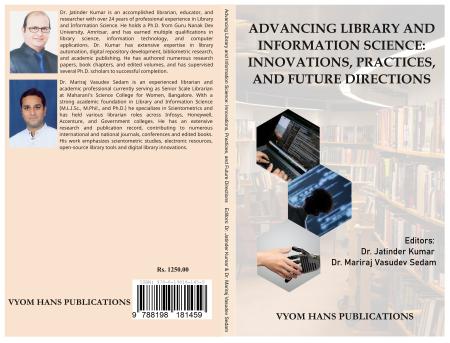
Sharad Maurya. (2025). PRESERVING BORN-DIGITAL CONTENT . In Dr. Jatinder Kumar & Dr. Mariraj Vasudev Sedam (Eds.), Advancing Library and Information Science: Innovations, Practices, and Future Directions (pp. 139-144). Vyom Hans Press. https://doi.org/10.34256/vadlibs.25.11.139